Welcome to Pathstone.

775+ team members.*
Specialized expertise.
$185B+ in aggregate assets.**

Choose the site experience most relevant to you:

Individuals & Families

An individual or family navigating the complexity of significant, multigenerational wealth and seeking a trusted partner for stewardship, strategy, and legacy.

Family Offices

A privately held company managing the financial, legal, and personal affairs of a wealthy family, providing tailored support with discretion and foresight.

Institutions

A mission-driven foundation, endowment, or organization seeking strategic financial oversight, governance support, and long term impact.

When Your Wealth Advisory Relationship Changes, What Should You Consider?

Perspective & Analysis

November 10, 2026

Your trusted advisor proposes a move. Your service team changes. Your family’s needs evolve.

Any of these moments can prompt you to take a closer look at your advisory relationship. Perhaps you are comfortable with the proposed direction. Perhaps you have questions about what it means for your family. Or perhaps it brings attention to needs you have been considering for some time.

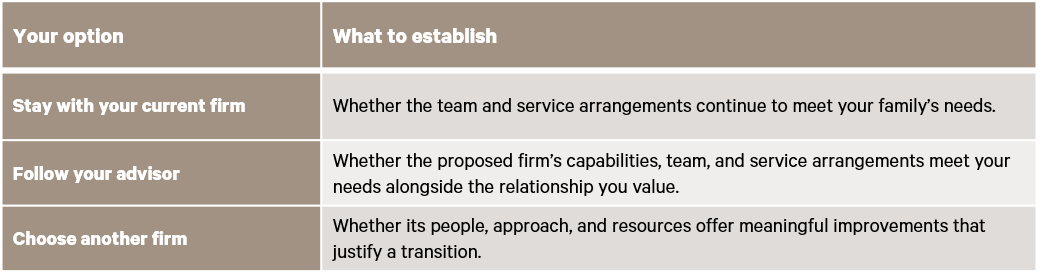
Start by establishing what will change for you. Then evaluate the people, capabilities, continuity, fees, and service arrangements behind your options. A change at a firm does not, by itself, tell you whether the relationship remains right for your family. What matters is how you will be served.

Start with what changes for your family

Ask your advisory firm to explain any changes to your primary advisor, supporting team, specialist access, investment arrangements, fees, or ongoing responsibilities. Clarify what is confirmed and what remains to be determined.

If your advisor proposes moving to another firm, request the same explanation about the new arrangement. Understand what the move is intended to improve, what will remain consistent, and what it will require from you.

If you are considering following your advisor

An advisor who knows your family may have earned your trust over many years. That relationship deserves weight in your decision. Joining their new firm also means choosing the organization, resources, and arrangements that will support their advice.

Ask which team members and capabilities will be available to you. Understand how investment access, reporting, fees, and coordination with your other professionals would work.

Evaluate both the experience of the people and the organization supporting them. An established firm should be able to explain how its record and resources translate into service for your family. A newer firm should be able to explain how its team’s experience, operating arrangements, and resources will meet your needs.

You can value your advisor’s judgment and take time to evaluate the full proposal. These five questions can help you make an informed choice.

1. How does the firm support continuity over time?

Continuity means preserving knowledge, accountability, and service as your family and advisory team evolve.

Consider the firm’s record and the practices behind it. Ask how it has handled advisor retirements, leadership transitions, and changes in client needs. Seek examples of how responsibilities were transferred and relationships sustained. Where the organization has a shorter history, examine the relevant experience of its people and the arrangements already in place.

Look closely at the team that would serve you. Multigenerational advisory teams can support continuity by bringing experienced and emerging advisors into the relationship together. Meaningful participation allows successive generations of advisors to understand your family, contribute to decisions, and earn trust before a handoff becomes necessary.

Ask who would be involved today, how responsibilities are shared, and how the firm prepares future relationship leaders. Shared documentation, service coverage, and succession planning should reinforce those working relationships.

Team members and responsibilities may change over time. Ask how the firm plans for those changes and communicates them to clients.

Continuity also involves the next generation of your family. How would the team build relationships with your children, understand their perspectives, and support their growing responsibilities?

2. Who connects the decisions across your financial life?

Families often have capable investment professionals, accountants, and attorneys. What may be less clear is who brings their advice together.

An investment sale can affect your tax position. A gift to a trust can change your liquidity needs. A business transition can reshape your estate plan and philanthropic intentions.

Ask each firm to explain how it would coordinate a decision relevant to you. Who identifies the connections? Who brings the appropriate professionals into the conversation? Who explains the tradeoffs and follows through? Also ask how much of that expertise is in-house, outsourced, or even off-shored.

Consider a hypothetical family planning to fund a trust while meeting private investment commitments and purchasing a home. Each decision may draw on the same resources. A coordinated review would consider the timing of those obligations, available liquidity, potential tax consequences, and investment objectives together.

You should understand who is responsible for coordinating the advice and which responsibilities remain with you or your other professionals.

Effective coordination can build on relationships you already value. Clarify how the firm would work with your existing attorneys, accountants, and other advisors, and where additional expertise could help.

3. How will the firm’s expertise be applied to your family?

A firm’s capabilities become meaningful when you understand how they would address your circumstances.

Ask how investment research, portfolio management, tax planning, estate planning support, and other relevant disciplines would contribute to your advice. Which professionals would work with you? When would they become involved? How would they stay informed as your needs change?

Bring a real question to the discussion: a concentrated stock position, an upcoming business sale, a trust arrangement, or a concern about your family’s financial responsibilities. Ask who would participate, what information they would need, and how recommendations would become action.

Understand which services are provided by the firm, through affiliates, or by outside professionals. Clarify what is included in your engagement and what requires separate arrangements or fees.

Confirm that the capabilities your family needs are available when you need them, and understand how any gaps would be addressed.

Look for clear explanations of how the team works, how responsibilities are assigned, and how progress is communicated.

4. Does the relationship support the life your family wants to build?

An advisory relationship established years ago may have been designed around circumstances that have changed.

You may now be preparing to leave a business, pursuing a new ambition, supporting aging parents, or helping adult children take on greater responsibility. Your spouse or partner may have priorities that have not been fully explored.

Those circumstances should influence the advice you receive.

Can your advisor explain what matters most to your family and show how that understanding has shaped a recommendation? Does the team anticipate decisions you will face? Do the people affected by those decisions have an appropriate voice? Does the firm as a whole have the services that will best support your preferred life?

For families thinking across generations, ask how the firm helps younger members develop financial confidence, approach shared decisions, and establish their own advisory relationships. Explore how it accommodates different priorities while respecting individual privacy and independence.

Your wealth has a purpose in your life. The advisory relationship should remain attentive to that purpose as your family evolves.

5. What would a change improve—and what would it require?

Identify what you want to preserve, what is missing, and what you would want a different arrangement to improve.

Ask each firm to explain how it would address those needs. Be specific about the people, services, and working practices you would expect. Consider whether improvements could be made within your existing relationship as well as through a move.

If you are considering a transition, request a review of assets, account arrangements, private investments, lending, fees, and upcoming obligations.

Which assets could transfer? Which might need to remain in place? Could proposed changes create taxes, costs, or restrictions? Who would coordinate the process, and how would ongoing responsibilities be covered?

If you have experienced earlier transitions, use that experience to set expectations. Discuss what worked well and what you would want handled differently.

A decision to move should have a clear purpose, with benefits and tradeoffs you understand before authorizing changes.

Practical questions about changing advisors

Should I follow my advisor to a new firm?

Following your advisor may be the right choice when the relationship and the proposed firm’s capabilities fit your needs. Evaluate the full arrangement, including the supporting team, breadth of services you will have available, continuity practices, fees, and service commitments. Your trust in the advisor is an important part of that assessment, but not the only factor.

Will changing advisors require selling my investments?

Not necessarily. Some holdings may transfer without being sold, depending on the investment, receiving custodian, and applicable restrictions. In some cases, changing advisors may not require changing custodians. Request a review of your holdings and arrangements before authorizing transfers or sales, including any potential costs and adverse tax consequences.

What costs should I ask about?

Ask about advisory fees, underlying investment expenses, transfer or termination charges, and separate planning or administrative fees. Determine whether services you might need come only bundled, or whether they can be unbundled and customized to your specific needs. Understand whether proposed portfolio changes could create transaction costs or taxes. The relevant costs depend on your agreements, holdings, and proposed changes.

How can I reduce the burden on my family?

Ask for a transition plan with a named lead, clear responsibilities, and a sequence that accounts for upcoming obligations. Confirm how records, cost-basis information, account instructions, and outstanding commitments will be checked. Establish which actions require your involvement and which the team will coordinate.


A relationship built around your family’s future

At Pathstone, we begin with what matters to you and your family—the life you want your wealth to support. We call this your Preferred Life.

Our approach brings together investment management and planning across areas such as tax, estate[1], risk management, philanthropy, and family governance, all under one roof. We seek to connect those disciplines around your circumstances, working with your other professional advisors and drawing on expertise relevant to your needs. The services and providers involved depend on your engagement.

Pathstone’s approach includes multigenerational advisory teams. Ask how the team proposed for your family would share responsibilities, develop relationships across generations, and plan for future transitions.

We welcome the same questions this article encourages you to ask of any firm. You should understand the  people, capabilities, service scope, and costs of a Pathstone relationship before deciding whether it is right for you.

Before you decide, get a clearer view of your options.

Bring us the questions you are weighing: what you want to preserve, what you would like to improve, and what you need to understand about a possible transition.

In an introductory conversation, we can help you identify the issues to examine and explain how Pathstone would approach your family’s needs. You can begin that discussion while you are still considering your options.


If you have any questions or would like to discuss the key takeaways presented here, we encourage you to contact your advisor or click below.

Start a conversation


[1] As a registered investment adviser, Pathstone does not offer legal advice, and registration does not imply a certain level of skill. While Pathstone may offer accounting and tax services, clients should consult qualified professionals as needed.

DISCLOSURES

This presentation and its content are for informational and educational purposes only and should not be used as the basis for any investment decision. The information contained herein is based on publicly available sources believed to be reliable but not a representation, expressed or implied, as to its accuracy, completeness or correctness. No information available through this communication is intended or should be construed as any advice, recommendation or endorsement from us as to any legal, tax, investment or other matters, nor shall be considered a solicitation or offer to buy or sell any security, future, option or other financial instrument or to offer or provide any investment advice or service to any person in any jurisdiction. Nothing contained in this communication constitutes investment advice or offers any opinion with respect to the suitability of any security, and this communication has no regard to the specific investment objectives, financial situation and particular needs of any specific recipient. Past performance is no guarantee of future results. Results may vary. Additional information and disclosure on Pathstone is available via our Form ADV Part 2A, which is available upon request or at www.adviserinfo.sec.gov.

Pathstone provides a wide range of services to help clients pursue their financial goals. References to specific services are illustrative and may not be available in all situations. Engagement with Pathstone does not guarantee specific outcomes. Additionally, some services may be delivered by third-party service providers, either engaged by Pathstone or directly by clients, and are subject to separate agreements. Pathstone makes no warranties regarding third-party services and assumes no liability for their use. As a registered investment adviser, Pathstone does not offer legal advice, and registration does not imply a certain level of skill.

While Pathstone may offer accounting and tax services, clients should consult qualified professionals as needed. Any tax-related information contained herein, including attachments, is not intended or written to be used, and cannot be used, by a taxpayer for any purpose, including (i) avoiding tax penalties that may be imposed on the taxpayer, or (ii) promoting, marketing or recommending to another party any transaction or matter addressed herein. Pathstone does not offer or sell medical, life, disability, long-term care, or other forms of insurance, and is not licensed as an insurance broker or agent. While Pathstone may review existing insurance policies, provide general recommendations, and refer clients to licensed insurance professionals (without receiving compensation), these services are provided solely to support clients’ broader financial planning needs and should not be construed as a solicitation or sale of insurance products.


Recent Insights

October 26, 2026

I Hate Trust Fund Babies.
Wait, Am I a Trust Fund Baby?

Inherited wealth often comes with narratives that can fuel internal conflict. But we have the agency to write our own stories.

October 10, 2026

AI and Macro Risks Remain the Story

Quarterly Market Insights: Strong earnings growth, resilient consumers, and elevated investment in AI still support equity markets. But higher interest rates, geopolitical uncertainty, and narrowing market leadership create a challenging backdrop.

October 8, 2026

Turning Complexity into Coordinated Action at Year-End

Effective year-end planning requires families to consider both the technical details and the broader priorities those decisions are meant to support.

October 6, 2026

The Case for Flexibility in Trust Design

An incentive trust is a tempting way to embed family values for the future, but guidance, judgment, and flexibility may be more effective tools.


Media Inquiry

We appreciate your interest in Pathstone. If you’re a journalist, producer, or media representative looking to contact our team, please complete the form below and we will connect you with the right spokesperson.

Contact detail:
General Inquiry

Have a question for our team? We’re happy to help.

Contact detail: